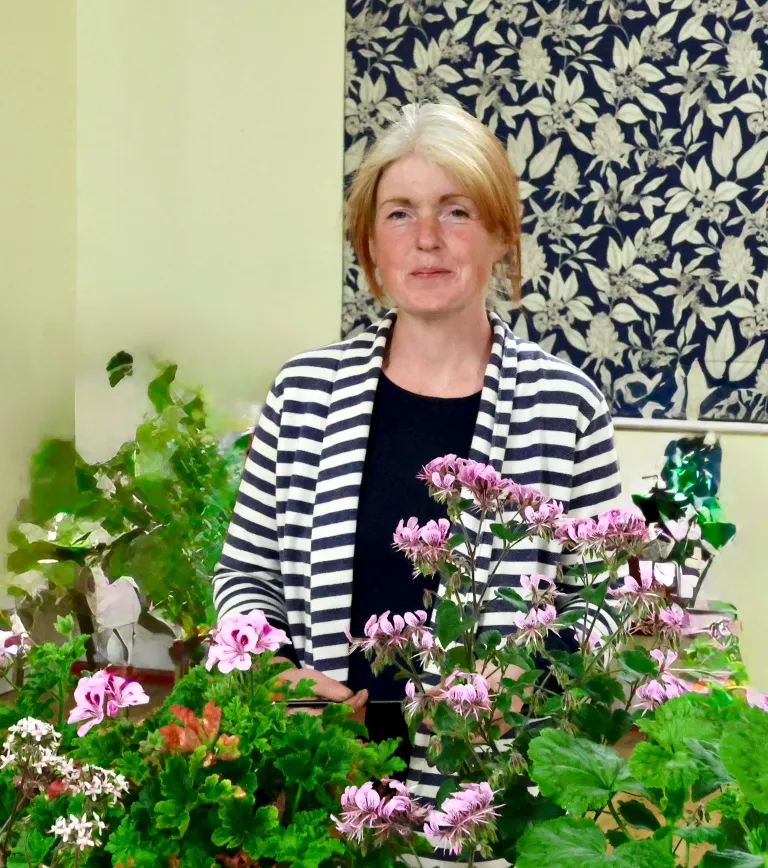
On a sunny April afternoon members attended a presentation by Luci Skinner on all things Pelargoniums. Luci is a horticulturist who runs her own plant advisory service and specialises in pelargoniums. Luci currently holds an RHS national collection of Pelargoniums, many of which she brought along for members to view and inspect during the tea break.
Luci started her presentation by discussing what is a pelargonium. Pelargoniums are a genus of about 280 species of tender, evergreen perennials, often incorrectly labelled ‘geraniums’ in garden centres to this day. A frost tender perennial plant (will survive down to -5oC) that can last well over 5 years with a good care regime. They originate from South Africa and are long flowering, drought tolerant plants that belong to the geraniaceae family, closely related to hardy geraniums.

Pelargoniums can be identified by having 2 upper petals and 3 lower petals, often featuring markings, with 7 stamens. The confusion in the naming of pelargoniums and geraniums stems from the great Swedish biologist Carl Linnaeus, who proposed the modern system of naming plants, and as such is known as the father of taxonomy. Despite indications to the contrary Linnaeus insisted that these plants from South Africa were the same as ‘Geraniums’ and placed both species under the same name. It was not until 30 years in 1789 that pelargoniums were shown to be a different genera to geranium. Geraniums have 5 equal petals, 10 stamens and die back in winter.
Luci then covered the different species of pelargoniums with a diverse range of leaf shapes, including planate and kidney shaped. Some species are tuberous and others have succulent stems or knobbly stems. Some of the benefits of growing pelargoniums in your garden are that they are long-flowering, scented, drought tolerant, long lived, insect repellant and some have medicinal or culinary properties. The downsides include their frost tender nature, care with watering (need to stay dry in winter) as prone to fungal disease. Luci completed her presentation by detailing how to care for these lovely plants on a month by month basis throughout the calendar year. The meeting closed with a Q&A and members eagerly purchasing some of the pelargoniums Luci brought for sale.
Luci started her presentation by discussing what is a pelargonium. Pelargoniums are a genus of about 280 species of tender, evergreen perennials, often incorrectly labelled ‘geraniums’ in garden centres to this day. A frost tender perennial plant (will survive down to -5oC) that can last well over 5 years with a good care regime. They originate from South Africa and are long flowering, drought tolerant plants that belong to the geraniaceae family, closely related to hardy geraniums.
Pelargoniums can be identified by having 2 upper petals and 3 lower petals, often featuring markings, with 7 stamens. The confusion in the naming of pelargoniums and geraniums stems from the great Swedish biologist Carl Linnaeus, who proposed the modern system of naming plants, and as such is known as the father of taxonomy. Despite indications to the contrary Linnaeus insisted that these plants from South Africa were the same as ‘Geraniums’ and placed both species under the same name. It was not until 30 years in 1789 that pelargoniums were shown to be a different genera to geranium. Geraniums have 5 equal petals, 10 stamens and die back in winter.
Luci then covered the different species of pelargoniums with a diverse range of leaf shapes, including planate and kidney shaped. Some species are tuberous and others have succulent stems or knobbly stems. Some of the benefits of growing pelargoniums in your garden are that they are long-flowering, scented, drought tolerant, long lived, insect repellant and some have medicinal or culinary properties. The downsides include their frost tender nature, care with watering (need to stay dry in winter) as prone to fungal disease. Luci completed her presentation by detailing how to care for these lovely plants on a month by month basis throughout the calendar year. The meeting closed with a Q&A and members eagerly purchasing some of the pelargoniums Luci brought for sale.