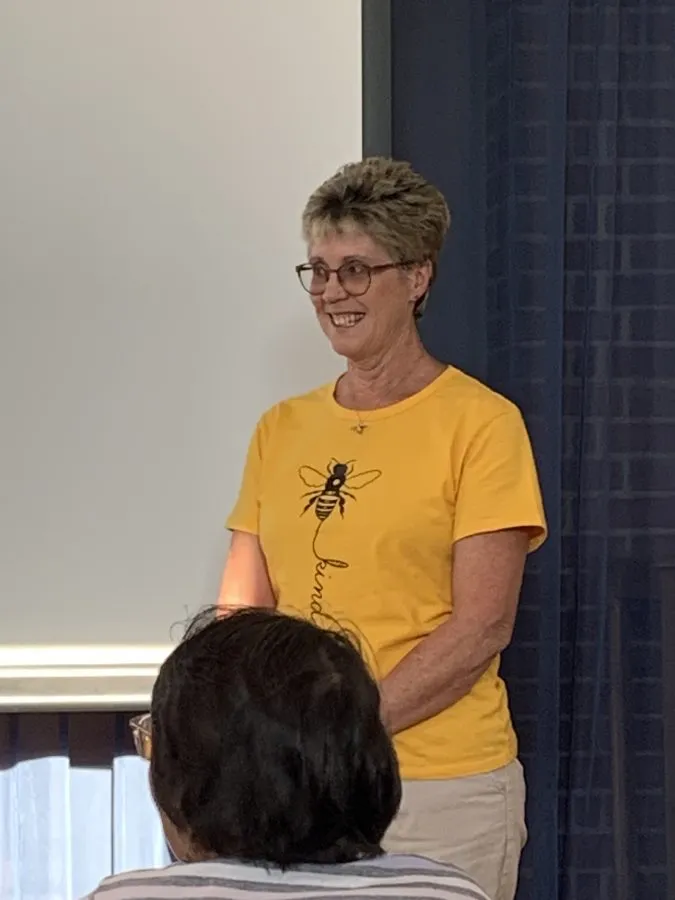
Lynda started her presentation with some statistics on bees, informing us that there are 250 different bee species in the UK, of which 197 are found in our rural county of Norfolk.

Lynda provided some fascinating facts around the dynamics of a bee hive, which revolves around the Queen bee, with her prodigious laying of eggs at the rate of 1,500 to 2,000 eggs per day in spring when building up the colony. Because worker bees only live for a few weeks to months the queen has to keep producing new progeny, which can amount up to a million eggs in her lifetime. A typical hive will have around 50,000-60,000 bees. Invasive species, such as the Asian Hornet, are a major predator for our native bees, with a hornet eating up to 50 bees per day, which they predate on the wing.

By planting long flowering plants such as catmint, geraniums and borage gardeners can give bees a food source all through spring and summer. Bees particularly like small open flowers, as they are more accessible. Certain plants are a great source for premium honey, such as Leptospurmum scoparium, native to New Zealand and Australia, which produces Tea tree honey, commonly known as Manuka honey. The presentation finished with lively Q&A and a number of members went away with a view to learning how to take up bee-keeping. There are several regional Norfolk bee-keeping clubs who offer courses to learn how to do this and provide advice and support to new bee-keepers.
Lynda provided some fascinating facts around the dynamics of a bee hive, which revolves around the Queen bee, with her prodigious laying of eggs at the rate of 1,500 to 2,000 eggs per day in spring when building up the colony. Because worker bees only live for a few weeks to months the queen has to keep producing new progeny, which can amount up to a million eggs in her lifetime. A typical hive will have around 50,000-60,000 bees. Invasive species, such as the Asian Hornet, are a major predator for our native bees, with a hornet eating up to 50 bees per day, which they predate on the wing.
By planting long flowering plants such as catmint, geraniums and borage gardeners can give bees a food source all through spring and summer. Bees particularly like small open flowers, as they are more accessible. Certain plants are a great source for premium honey, such as Leptospurmum scoparium, native to New Zealand and Australia, which produces Tea tree honey, commonly known as Manuka honey. The presentation finished with lively Q&A and a number of members went away with a view to learning how to take up bee-keeping. There are several regional Norfolk bee-keeping clubs who offer courses to learn how to do this and provide advice and support to new bee-keepers.